
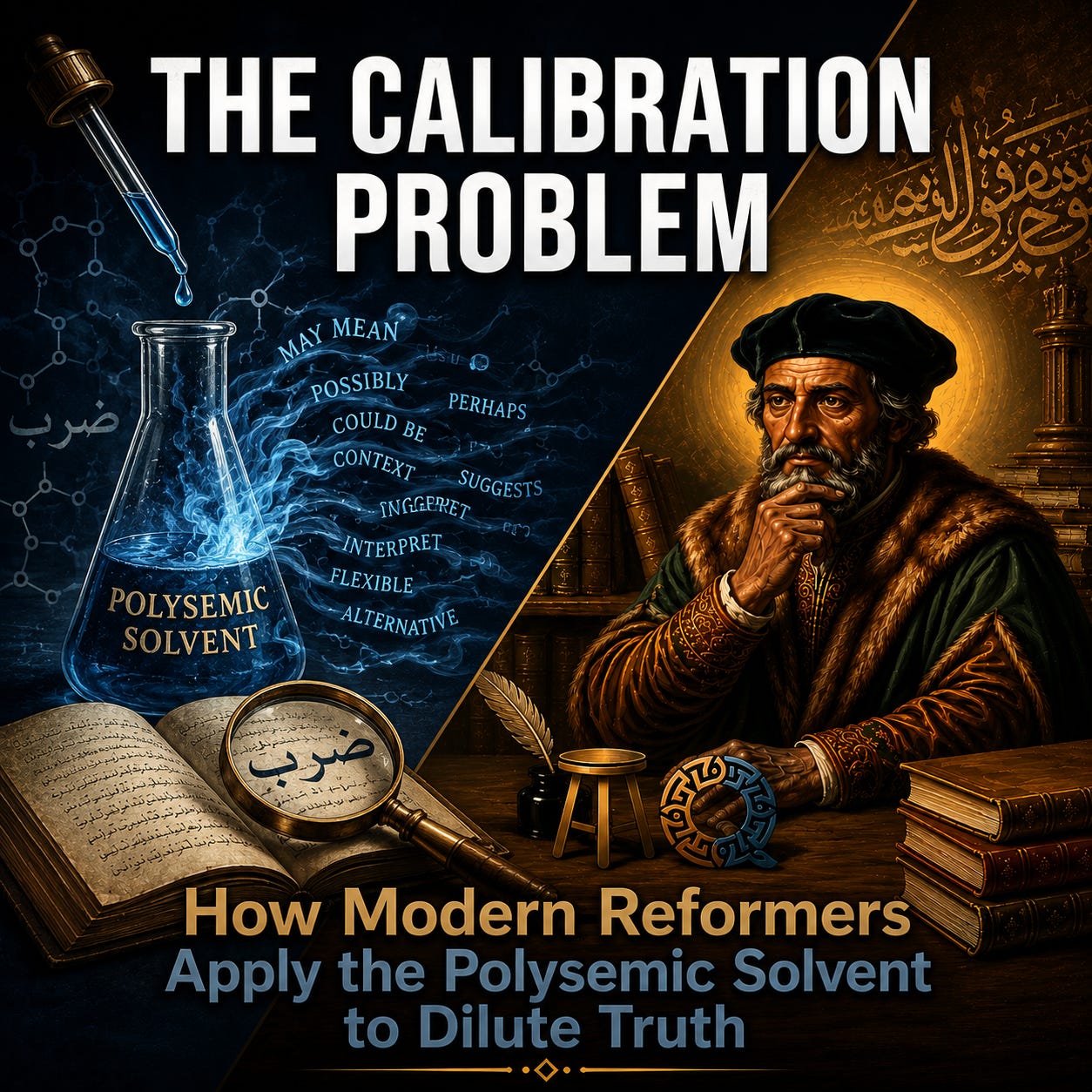
Recap
In the three-part series of my article The Calibration Problem, I laid bare the blind spots in our reasoning process and how we can take a structured approach toward evaluating a belief on the basis of its coherence, correspondence with reality and calibration—the capacity to detect truth from error. I also explained how assumed conclusions baked into the premise are the Achilles heel of human decision making. This is because how we are calibrated governs what we choose to call coherent and correspondent with lived experience. But because anthropocentric calibrations can result in a distorted view of reality at the level of first principles, what we choose to accept as evidence can naturally lead us to flawed conclusions. Modern secular frameworks often mask these distortions as fair and enlightened to their adherents, but because they are decoupled from divine truth, reality eventually pulls back the curtain and reveals their consequences much later.
I will now apply the methodology developed in this trilogy to a polysemy1 misuse case study and demonstrate how our ex ante calibration tainted by secular morality and modern sensibilities can influence how we interpret the Qur’an regardless of its perceived neutrality.
The Calibration Problem in Modern Hermeneutics
Many truth seekers within the Qur’an-alone community are not immune to blind spots, where their calibration can be geared toward optimizing for social consensus, conformity with modernity, or some other target that prioritizes a certain convenient criterion over truth.
Here, I will refrain from critiquing the interpretation of divine text through the filter of later tradition, commentaries, or sectarian literature as enough has already been said on the subject. Its composite authorship, chronological distance from revelation, and internal contradictions drastically impact both coherence and correspondence assessment. My focus is entirely on the proliferation of interpretations of the Qur’an designed to preserve modern sensibilities, together with attempts to invoke scientific theories to prove its divinity—which positions shifting human consensus as the ultimate validator of divine speech. This has created what I call throughout this article series the calibration problem—upstream commitments that determine how we decide what is coherent with our beliefs and corresponds with reality as we experience it. These calibrated assessments then become the evidence from which we draw our conclusions. This is hardly surprising considering the level of atomization humanity has steadily gone through as a civilization along the trajectory of modernity.
Compassion, courage, justice, duty and patience are all human virtues. When one is prioritized over another depends on the circumstance. A calibration that is always optimized for compassion may not always align with truth and may merely relocate injustice elsewhere. As we saw earlier with the debt-based welfare-system example, compassion toward the present generation can relocate injustice onto future generations who never benefited from the scheme. There is therefore no reason for us to assume that compassion, or an outcome that brings the least amount of discomfort to a particular demographic, should function as the epistemic criterion by which lexical meaning is determined. Whether the prioritized optimization criterion coincides with the Qur’an’s own text must be demonstrated, not assumed.
This explains why equally sincere interpreters can arrive at radically different conclusions: they are optimizing different calibrations.
One optimizes social harmony and human happiness.
Another minimizes perceived harm.
Another maximizes for embracing modernity.
But these optimizations are often in tension with a reading that emphasizes global textual coherence, correspondence with the rules of language, and calibration tuned to accepting the Qur’anic verdict even when it leads to a discomforting truth. Anthropocentric optimization targets and divine truth criteria are not the same thing. Human-centered reasoning may remain coherent within its respective calibration, progressively diverging from reality as unintended consequences reveal themselves with a temporal lag as shown through examples in Parts II and III of The Calibration Problem article.
The meaning of certain words can drift over time in a society and be weaponized to serve prevailing narratives. The propensity to associate negative moral connotations to neutral descriptive terms such as patriarchy and masculinity, the appeal to emotion and compassion to flatten traditional roles, and social conditioning that frames physical punishment as a medieval practice unsuited for an “enlightened” science-driven civilization can prejudice the interpretation before the analysis has even begun. Lack of awareness of these mental blind spots can lead us away from divine truth.
This is the hidden calibration error the CCC Framework is designed to expose. The interpreter thinks he is interpreting the text, while in reality he has installed his own moral intuition—predicated on modern sensibilities and emotional moralism—as the external calibrator of revelation.
Compassion and mercy are virtues, but virtues do not themselves function as epistemic criteria for determining the meaning of a text. Revelation defines the virtue; the virtue alone cannot dictate the definition of the revelation.
Misuse of Polysemy
Polysemy is the idea that a single lexical item has multiple semantic meanings. In the Qur'an, it is the existence of multiple meanings originating from a single lexical root word. These meanings are not freely interchangeable but are constrained by morphology, syntax, collocation, surrounding textual context, and, above all, the Qur'an's internally coherent pan-textual usage.
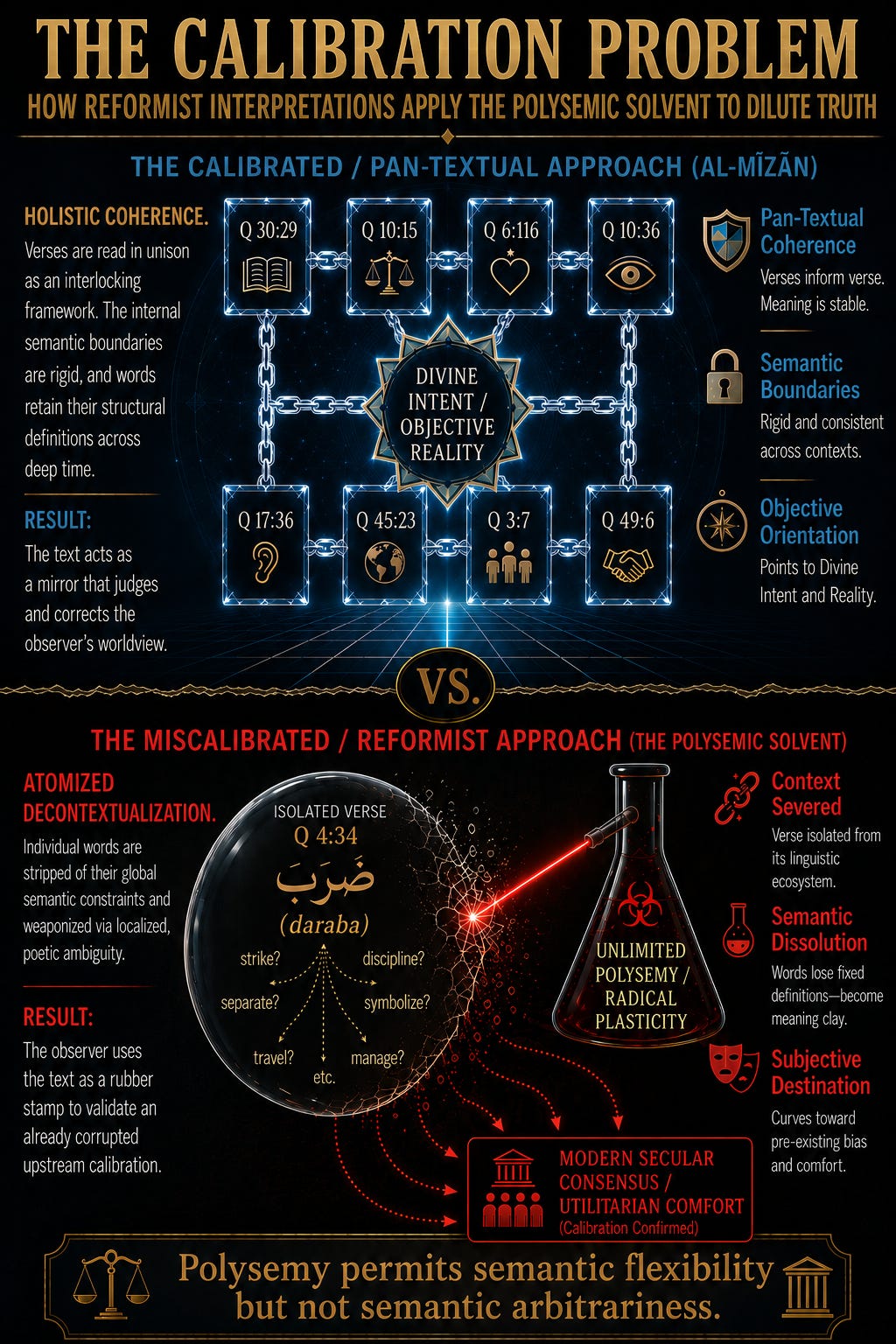
Many modernist interpreters, influenced by Western ideals that have steadily drifted toward moral relativism over generations, think that because Arabic words have multiple lexical meanings, they can freely choose the most obscure, low-friction, modern-friendly definition of a word (like ḍaraba, qawwāmūn, etc.) to erase traditional hierarchies. As shown in the illustration above, they use the polysemic solvent to dissolve divine structural boundaries to fit the already "assumed conclusion" of modern consensus.
These interpreters want the social and spiritual capital of saying “God says” by leaning on the Qur’an without letting go of the moral comfort of modern secularism that brings them the least amount of discomfort. But in the Qur’anic teleological framework where reality is designed to test man, this is exactly the kind of trial (fitnah) one should expect to see play out.
In today’s relativized world, coherence can feel like coercion. When we reject a pan-textual, coherent whole, we reduce the text to a mirror of our own upstream desires, allowing us to perform ad hoc rescues to make the text fit modern trends. Later we shall see whether the reformist is actually using polysemy to discover meaning or using it to escape the meaning that a pan-textual reading would otherwise impose.
To conclude, for humans, calibration doesn’t merely come first—it governs the entire reasoning process. The desired outcome is determined by that calibration, and the verses and lexical terms that do not align with that expectation are subsequently reinterpreted—often via semantic gymnastics that ignore global text constraints—to serve it.
The key insight is this:
Polysemy permits semantic flexibility but not semantic arbitrariness.
In Part II, God willing, I will provide a case study of how calibration tuned to prevailing narratives can cloud our judgement, whereby polysemy is applied to derive a pre-decided conclusion under the cover of pan-textual analysis. The real danger then is not polysemy itself, but the calibration that decides which meaning the interpreter is willing to accept.
Transparency Note
AI tools were extensively used in drafting, refining and creating images for this article. Truth value, however, depends on calibration — not authorship romance. Epistemic responsibility for all arguments and conclusions remains with the author.
Polysemy is the concept that a single word or lexical root possesses multiple distinct meanings or semantic applications.
YouTube channel: https://www.youtube.com/@ArchitectureOfTruth